Start of the overlay
Image description

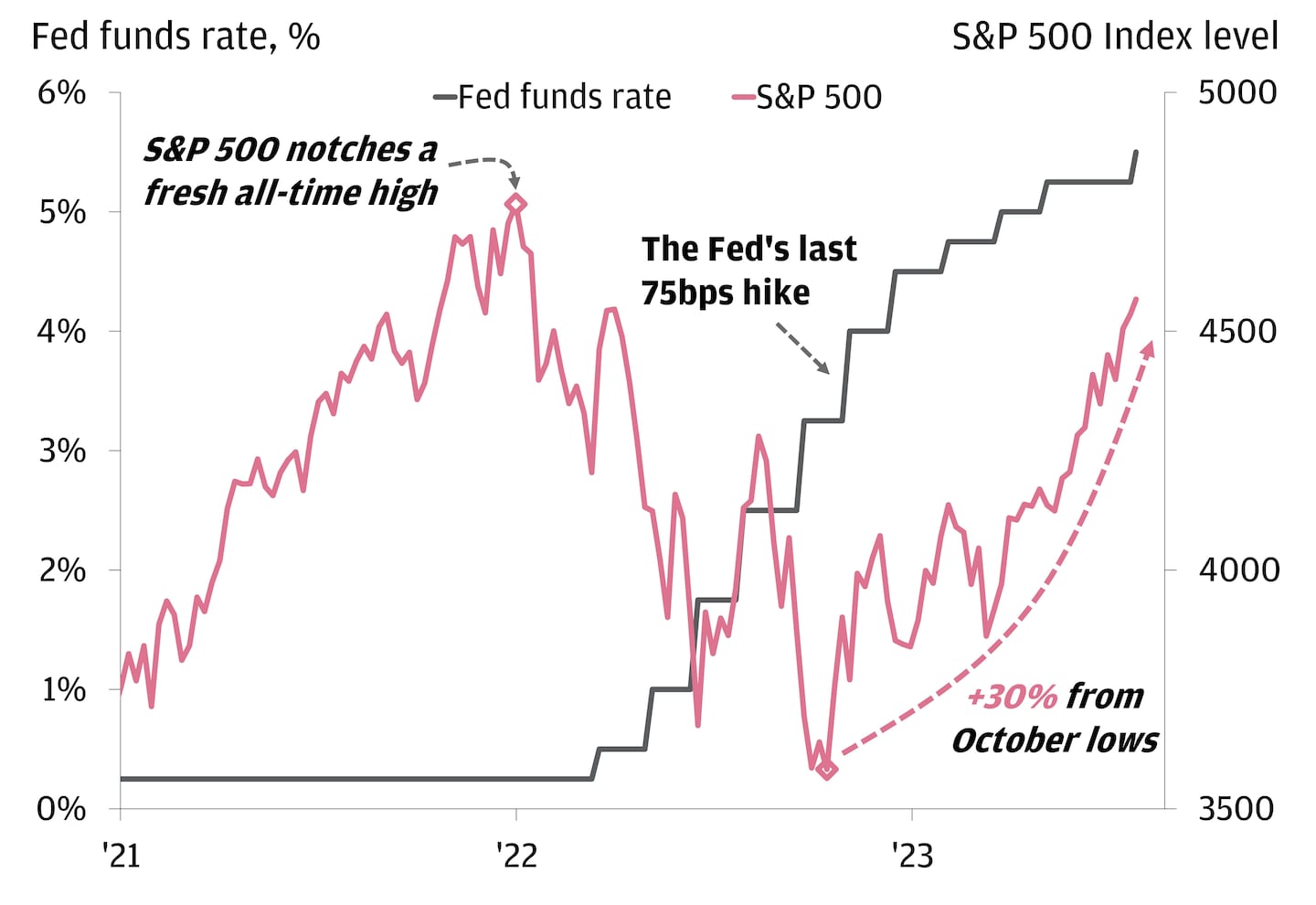
Fed funds rate vs S&P 500


The chart describes the percentage Fed funds rate versus the index level of S&P 500.


For the Fed funds rate line:


  • The first data point came in at 0.25% on January 1, 2021.
  • The line stayed flat until November 3, 2022.
  • After which it started heading up and the Fed raised 75 basis points of Fed funds rate in June 2022. 
  • The most recent data point which was 5.5% on July 26, 2023.


For the S&P 500 line:


  • The first data point came in at 3756 on January 1, 2021.
  • The line trended upward until it peaked at 4766 on December 31, 2021, where the S&P 500 notches a fresh all-time high.
  • Later it trended all the way down until it bottomed out at 3583 on October 14, 2022.
  • Then it went back up to and reached 4567 on July 26, 2023. The index has had more than 30% gain since the 2022 October low.
End of the overlay
Start of the overlay
Image description

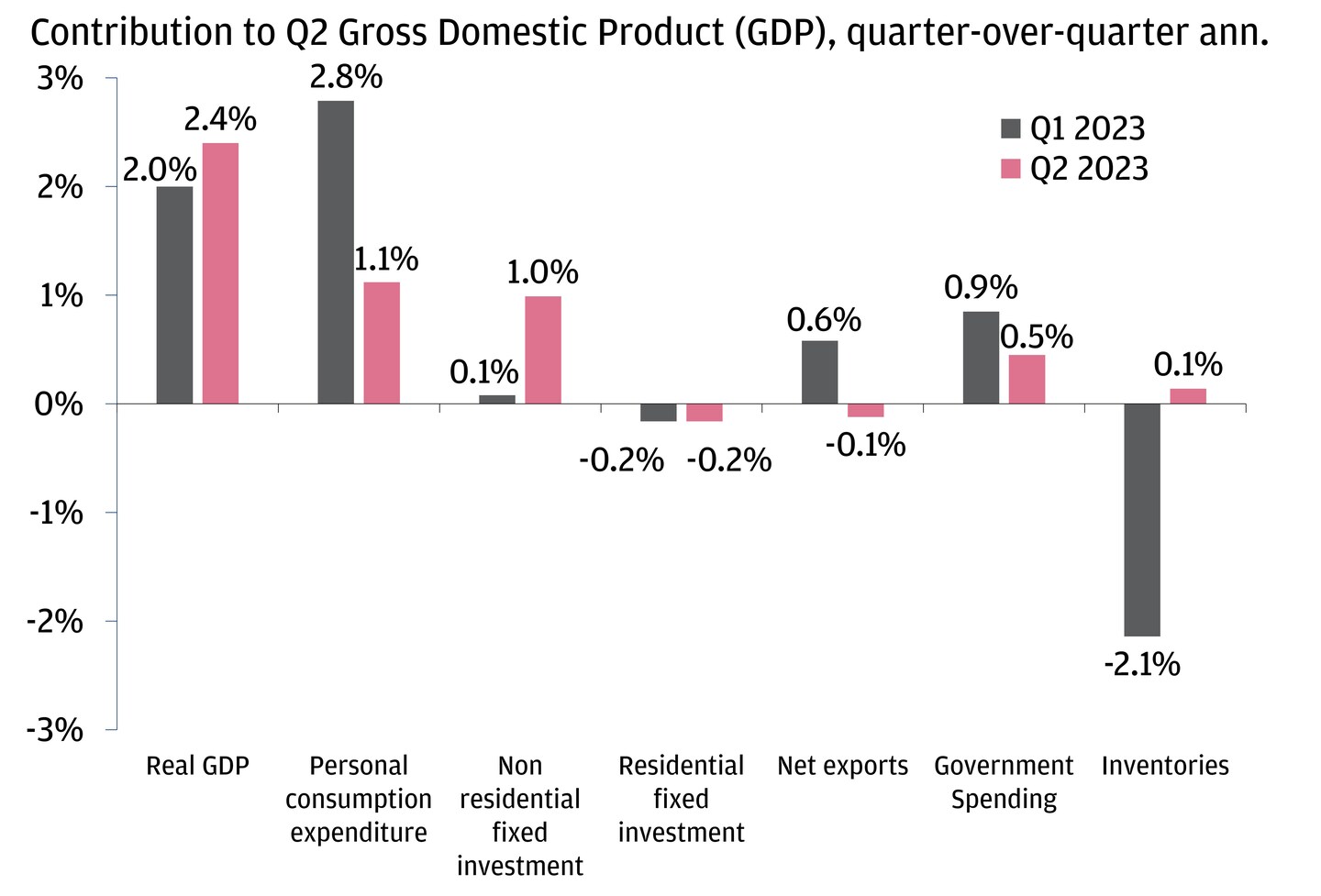
Contribution to Q2 Gross Domestic Product (GDP), quarter-over-quarter ann.


This bar chart shows the contribution by segment to U.S. Q2 Gross Domestic Product, quarter-over-quarter annualized from -3% to 3%:


  • Real GDP: 2.0% for Q1 2023 quarter-over-quarter GDP, and 2.4% for Q2 2023 quarter-over-quarter GDP.
  • Personal consumption expenditure: 2.8% for Q1 2023 quarter-over-quarter GDP, and 1.1% for Q2 2023 quarter-over-quarter GDP.
  • Non-residential fixed investment: 0.1% for Q1 2023 quarter-over-quarter GDP, and 1.0% for Q2 2023 quarter-over-quarter GDP.
  • Residential fixed investment: -0.2% for Q1 2023 quarter-over-quarter GDP, and -0.2% for Q2 2023 quarter-over-quarter GDP.
  • Net exports: 0.6% for Q1 2023 quarter-over-quarter GDP, and -0.1% for Q2 2023 quarter-over-quarter GDP.
  • Government Spending: 0.9% for Q1 2023 quarter-over-quarter GDP, and 0.5% for Q2 2023 quarter-over-quarter GDP.
  • Inventories: -2.1% for Q1 2023 quarter-over-quarter GDP, and 0.1% for Q2 2023 quarter-over-quarter GDP.
End of the overlay
Start of the overlay
Image description

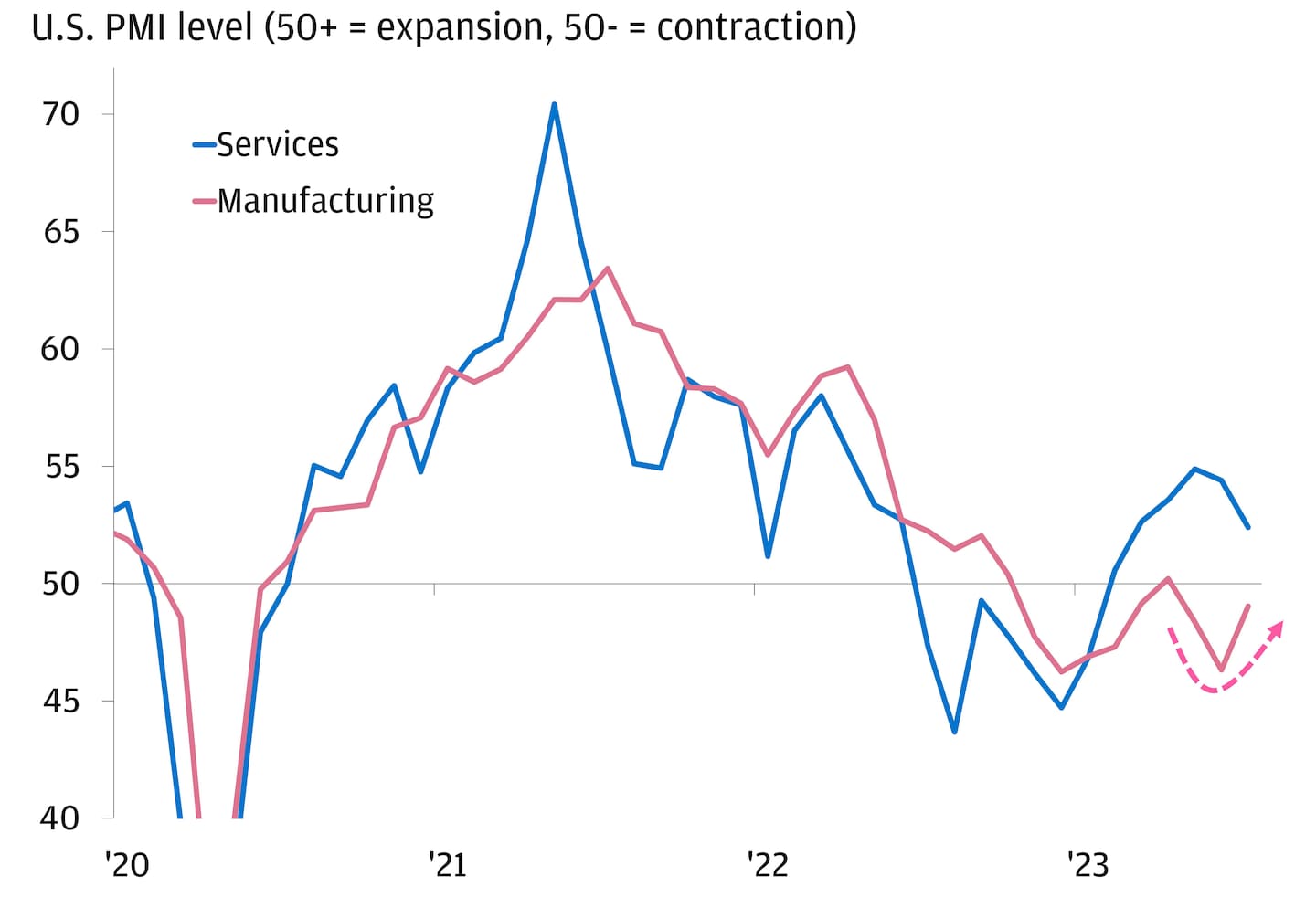
U.S. PMI level (50+ = expansion, 50- = contraction)


This chart shows the services, and manufacturing PMI level in two separate lines. It indicates that PMI level (50+ = expansion) and (50-=contraction).
Note that the x-axis is set at 50 to split up the expansion and contraction territory.
 
The services PMI line:


  • Started at 54 in January 2019.
  • It declined until its bottom at 27 in April 2020.
  • It trended upward and peaked at 70 in May 2022.
  • Then it trended downward and hit its bottom at 44 in August 2022.
  • In the end, it recovered and bounced back with the last data point at 52 in July 2023. 


The manufacturing PMI line:


  • Started at 55 in January 2019.
  • It declined until its bottom at 36 in April 2020.
  • It went back up and peaked at 63 in July 2021.
  • Then it trended downward and hit its bottom at 46 in December 2022.
  • In the end, it recovered and bounced back slightly with the last data point at 49 in July 2023.


The services PMI line has been converging with the manufacturing PMI with the services line going down and manufacturing line picking up.

End of the overlay
Start of the overlay
Image description

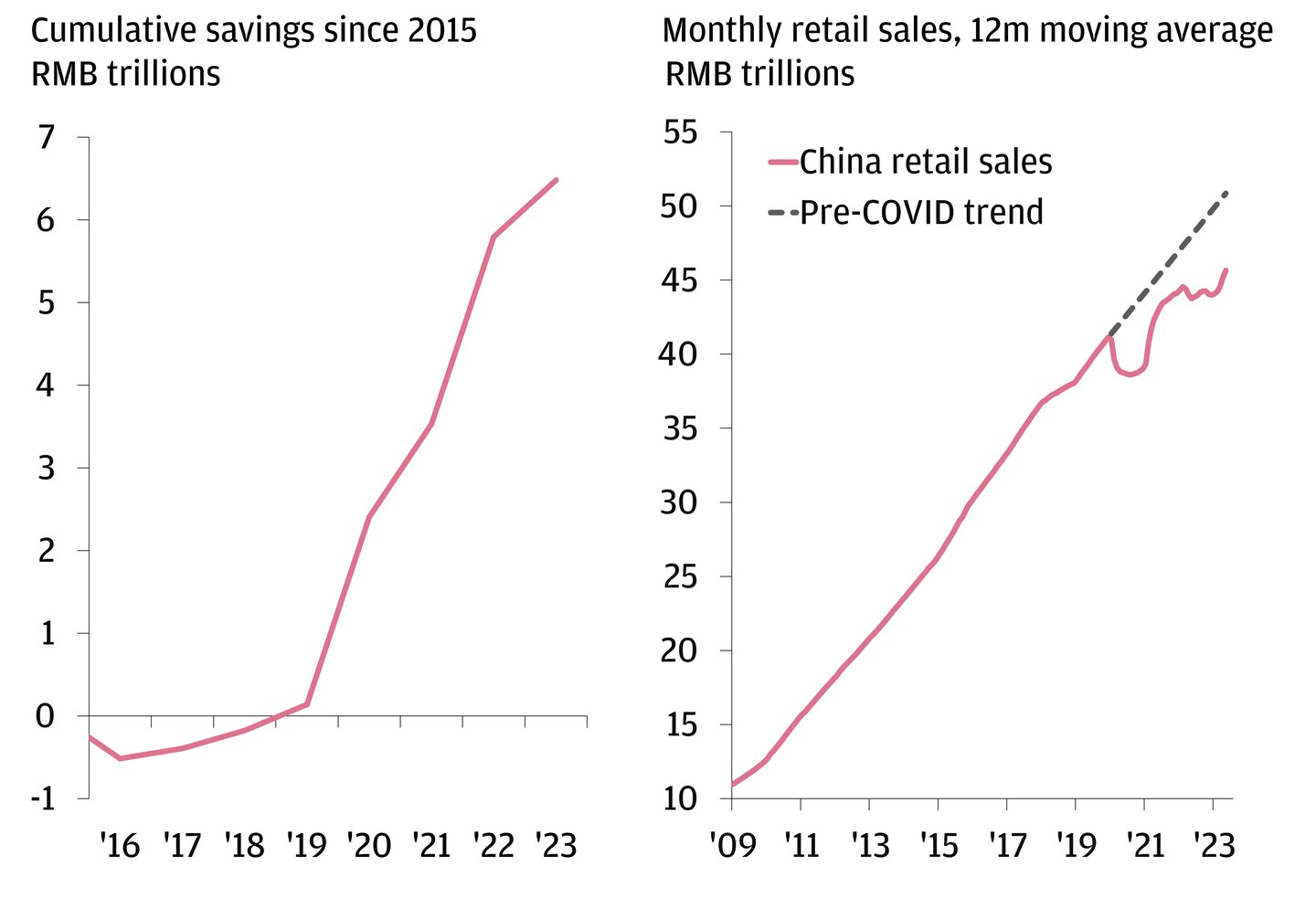
Cumulative savings since 2015 vs. Monthly retail sales, 12m moving average


The cumulative savings since 2015 of Chinese consumers (RMB trillions):


  • In 2016: -515,299
  • In 2017: -393,246
  • In 2018: 138,364
  • In 2019: 176,771
  • In 2020: 2,404,360
  • In 2021: 3,530,363
  • In 2022: 5,794,195
  • In 2023: 6,479,352.


Chinese monthly retail sales, 12 month moving average (RMB trillions):


  • In March of 2009: 112,304
  • In May of 2014: 245,671
  • In July of 2017: 351,883
  • In June of 2021: 431,663
  • In May of 2023: 456,450.


The pre-covid projection starting in 1/31/2020 at 416,127 trillion and it trended upward as a sloping line.

End of the overlay

Top Market Takeaways Barbie or Oppenheimer – what’s on the market’s big screen?

Published Jul 28, 2023

Market update: Team Barbie or Team Oppenheimer?


The great Barbenheimer debate is rife, and the economy and markets are weighing in. Today, we explore this week’s news flow and offer our thoughts on which side it takes.


1. On the Fed: Despite hiking to levels unseen in 22 years, stocks are having a party in Barbieland.


After over a year of tightening and a “skip” in June, the Fed may be drawing the curtain on its rate hikes. On Wednesday, the Fed hiked 25 basis points to a target policy rate of 5.25–5.5%. Just as expected.


The Fed isn’t taking a victory lap on its fight against inflation just yet, but with a lot of progress so far (at the same time the economy has stayed on solid footing), we think it’s probably the last hike of the cycle (or close to it). It could also be the start of the end of an era – the European Central Bank signaled it could be wrapping up hikes this week, and the Bank of Japan surprised by widening its yield curve control policy overnight.


Whether the Fed ultimately gets a reputation for achieving a soft landing or spurring a mild recession, stocks have moved on from the debate. After a rough 2022 as the Fed got going, the S&P 500 is now up some 20% this year and is less than 5% off of last January’s record highs. It’s also likely not a huge coincidence that the market bottomed around the same time the Fed delivered its final monster 75-basis-point hike (marking a slower pace from there).


Stocks seem to have moved on from rate hikes
This line graph describes the percentage Fed funds rate versus the index level of S&P 500.
Source: Bloomberg Finance L.P. Data as of July 26, 2023.
See expandable image , opens new browser window | Show text version, opens overlay

2. On the economy: Even the recessionistas can’t deny the recent Barbie vibes


The U.S. economy is still feeling good. Yesterday brought the official read on growth in the second quarter, with GDP printing at an above-expected 2.4%. The sources of the boost added to the flare – consumption saw a solid lift (from spending on both goods and services), prices cooled and capital expenditures spending popped thanks to industrial policies like the Inflation Reduction Act.

Q2 GDP showed the U.S. economy is in the summer mood
This bar chart shows the contribution by segment to U.S. Q2 Gross Domestic Product, quarter-over-quarter annualized.
Source: Bureau of Economic Data, Haver Analytics. Data as of June 30 2023.
See expandable image , opens new browser window | Show text version, opens overlay

Other measures sang to the same tune. The number of Americans that applied for unemployment benefits in the last week hit its lowest since February. And in a sign that last year’s downtrodden sectors may be finding their footing, a key leading indicator for manufacturing saw its first increase in three months as contracts to buy previously owned homes climbed.

Reshuffle: U.S. manufacturing could be finding its footing
This chart shows the services, and manufacturing PMI level in three separate lines.
Source: S&P Global, Haver Analytics. Data as of July 24, 2023.
See expandable image , opens new browser window | Show text version, opens overlay

Meanwhile, Europe is having a bit of a more Oppenheimer summer. Manufacturing activity worsened even more in June, services parts of the economy are now seeing softer momentum and business sentiment is also taking a hit (just look to Germany’s latest IFO reading). The upshot, though, is that inflation is also cooling – the bad news comes with some good.


3. On earnings: Oppenheimer may get this quarter, but Barbie is still working some magic.


This week marks the busiest for Q2 earnings.


The not-so-good news: So far, it’s shaping up to be the worst quarter since Q2 2020 (with consensus anticipating earnings to contract -7.5% year-over-year). While almost 82% of the companies that have reported have beaten estimates (handily above the 77% average over the last 5 years), they’re “only” beating at a rate of 6.5% (compared to the 8.4% 5-year average). That feels Oppenheimer-y.


But we also see some Barbie vibes. It could be the case that the bar was set pretty high heading into the season. That’s meant that names that have had a good run (like Microsoft, Netflix, Tesla or LVMH) are being punished for results that, to us, don’t look all that bad (or far from it). When you look under the hood, it’s still shaping up to be a decent season – even a good one – for many bellwether companies. Banks have done much better than expected (not to mention the PacWest and Banc of California merger was also good news for the sector this week), some other mega cap tech names are going from strength to strength, and a handful of consumer companies are showcasing still-robust spending.


4. On commercial real estate: Oppenheimer in the office space, but less gloomy as a whole.


CRE, especially in the office space, has been feared as one of the biggest ripple effects of the bank crisis.


The Oppenheimer crew might lean on climbing vacancy rates in big cities. Look no further than the latest cover1 of New York magazine. According to researchers2 from Harvard and MIT, there’s around 75 million square feet of vacant office space in New York City – enough to fill more than 26 Empire State Buildings!


And that stretches beyond just the Big Apple. Jones Lang LaSalle Inc. (JLL) recently noted that less than 5 million square feet of new offices have broken ground this year, while 14.7 million square feet have been axed – that’s the first net decline since at least 2000. This lack of income puts loans issued by banks for CRE at risk – but it’s still TBD what the correction will look like.


The Barbie folk might argue that the office sector represents such a small part of the overall economy (office construction remains a modest 0.4% of U.S. GDP), and that challenges here can’t be generalized. There’s certainly weight to that, but the risk of CRE loans to small banks probably gives this round to the Oppenheimer's for now.


5. On China: Policymakers are doing the Barbie song and dance, but growth has yet to get its heels back up.


Earlier this week, China’s Politburo (its top decision-making body) called for adding more support for the property sector (which continues to weigh on growth), improving domestic demand (to boost incomes and consumption in areas like travel, leisure and sports), and strengthening “counter-cyclical” adjustments.


The feel is that while it’s still China’s same brand of “mini easing,” the tone was more pro-growth and constructive than it has been. At some point, all the slow-moving stimulus could help move the needle, and get the consumer going. There’s still much progress to be made: Chinese consumers are sitting on hordes of excess savings, and retail sales are still 10% below their pre-COVID trend.

A catch-up play by the Chinese consumer could support growth
 

The line graph on the left shows the cumulative savings since 2016, the line graph on the right shows Chinese monthly retail sales starting in 2009.
Sources: (LHS) CNBS, JPM WM. Data as of March 2023. (RHS) Sources: CNBS, Haver Analytics. Data as of May 2023.
See expandable image , opens new browser window | Show text version, opens overlay

With all that in mind, the Hang Seng rounded out this week with a +4.7% gain.


And the winner is….


Both Barbie and Oppenheimer have blown past box office expectations, sending cinema stocks like AMC, IMAX and Cineworld soaring on Monday. Yet, it was Barbie that almost doubled Oppenheimer’s total sales during its opening weekend. While it’s yet to be seen if its hold remains, stocks at least seem to agree with the winner, and have continued their summer vibe-shift.


While it may not be all smooth sailing, the rally offers an opportunity to broaden and balance equity portfolios (into undervalued pockets of the market like mid-caps, dividend-growth companies and long-term trends around the energy transition, industrial policy and digital transformation). The recent pop in yields (10-year Treasury yields climbed back above 4% this week) offers a still-compelling entry point in fixed income. And with borrowers turning to alternative sources of lending as banks tighten their standards, now could be the time to take advantage of private credit and stressed/distressed opportunities.


Your J.P. Morgan team is here to discuss these dynamics, and maybe even offer their take on which flick they liked better.


All market data from FactSet and Bloomberg Finance L.P., 7/28/23.

Invest your way

Not working with us yet? Find a J.P. Morgan Advisor or explore ways to invest online. 

Continue

You may also like

Article Economic outlook Oil shocks, inflation and the AI buildout: Investing’s biggest risks and opportunities midway through 2026

J.P. Morgan Wealth Management’s Mid-Year 2026 Outlook highlights the pressure points and bright spots for investors in a world that’s moving fast.

7 min read
Top Market Takeaways

Article Top Market Takeaways How the market’s inflation fears are running ahead of reality

As markets reprice oil-driven inflation risk, global central banks offer a clearer signal on whether rate hikes are really coming.

Top Market Takeaways

Article Top Market Takeaways How tech became everything to everyone

From inflation worries to volatility spikes to the artificial intelligence (AI) buildout, investors keep leaning on tech. Earnings influence is becoming harder to ignore.

Invest your way

From online investing to working with an advisor, J.P. Morgan is ready to help you achieve your goals.

Continue, to investment offers page.

Footnotes

  • 1

    New York Magazine, “New Glut City: The city’s mega-office landlords are panicking, pivoting, and shedding what’s worthless. One opens his books.” (July 2023)

  • 2

    New York Times, “26 Empire State buildings could fit into New York’s empty office space. That’s a sign.” (May 2023)

Disclosures

Our Top Market Takeaways for July 28, 2023.


Investing in fixed income products is subject to certain risks, including interest rate, credit, inflation, call, prepayment and reinvestment risk.  Any fixed income security sold or redeemed prior to maturity may be s...

Read more disclosures about this article

Our Top Market Takeaways for July 28, 2023.


Investing in fixed income products is subject to certain risks, including interest rate, credit, inflation, call, prepayment and reinvestment risk.  Any fixed income security sold or redeemed prior to maturity may be subject to substantial gain or loss.


The price of equity securities may rise or fall due to the changes in the broad market or changes in a company's financial condition, sometimes rapidly or unpredictably. Equity securities are subject to 'stock market risk' meaning that stock prices in general may decline over short or extended periods of time.


Investors should understand the potential tax liabilities surrounding a municipal bond purchase. Certain municipal bonds are federally taxed if the holder is subject to alternative minimum tax. Capital gains, if any, are federally taxable. The investor should note that the income from tax-free municipal bond funds may be subject to state and local taxation and the Alternative Minimum Tax (AMT).


Index definitions:


Standard and Poor’s 500 Index is a capitalization-weighted index of 500 stocks. The index is designed to measure performance of the broad domestic economy through changes in the aggregate market value of 500 stocks representing all major industries. The index was developed with a base level of 10 for the 1941–43 base period.


The Bloomberg Eco Surprise Index shows the degree to which economic analysts under- or over-estimate the trends in the business cycle. The surprise element is defined as the percentage difference between analyst forecasts and the published value of economic data releases.


The NASDAQ 100 Index is a basket of the 100 largest, most actively traded U.S companies listed on the NASDAQ stock exchange. The index includes companies from various industries except for the financial industry, like commercial and investment banks. These non-financial sectors include retail, biotechnology, industrial, technology, health care, and others.


All market and economic data as of July 2023 and sourced from Bloomberg and FactSet unless otherwise stated.


We believe the information contained in this material to be reliable but do not warrant its accuracy or completeness. Opinions, estimates, and investment strategies and views expressed in this document constitute our judgment based on current market conditions and are subject to change without notice.


RISK CONSIDERATIONS

  • PAST PERFORMANCE IS NOT INDICATIVE OF FUTURE RESULTS. YOU MAY NOT INVEST DIRECTLY IN AN INDEX.
  • Structured products involve derivatives and risks that may not be suitable for all investors. The most common risks include, but are not limited to, risk of adverse or unanticipated market developments, issuer credit quality risk, risk of lack of uniform standard pricing, risk of adverse events involving any underlying reference obligations, risk of high volatility, risk of illiquidity/little to no secondary market, and conflicts of interest. Before investing in a structured product, investors should review the accompanying offering document, prospectus or prospectus supplement to understand the actual terms and key risks associated with the each individual structured product. Any payments on a structured product are subject to the credit risk of the issuer and/or guarantor. Investors may lose their entire investment, i.e., incur an unlimited loss. The risks listed above are not complete. For a more comprehensive list of the risks involved with this particular product, please speak to your J.P. Morgan team.
  • As a reminder, hedge funds (or funds of hedge funds) often engage in leveraging and other speculative investment practices that may increase the risk of investment loss. These investments can be highly illiquid, and are not required to provide periodic pricing or valuation information to investors, and may involve complex tax structures and delays in distributing important tax information. These investments are not subject to the same regulatory requirements as mutual funds; and often charge high fees. Further, any number of conflicts of interest may exist in the context of the management and/or operation of any such fund. For complete information, please refer to the applicable offering memorandum.
  • THE PRICES AND RATES OF RETURN ARE INDICATIVE, AS THEY MAY VARY OVER TIME BASED ON MARKET CONDITIONS.
  • ADDITIONAL RISK CONSIDERATIONS EXIST FOR ALL STRATEGIES.
  • THE INFORMATION PROVIDED HEREIN IS NOT INTENDED AS A RECOMMENDATION OF OR AN OFFER OR SOLICITATION TO PURCHASE OR SELL ANY INVESTMENT PRODUCT OR SERVICE.
  • OPINIONS EXPRESSED HEREIN MAY DIFFER FROM THE OPINIONS EXPRESSED BY OTHER AREAS OF J.P. MORGAN. THIS MATERIAL SHOULD NOT BE REGARDED AS INVESTMENT RESEARCH OR A J.P. MORGAN INVESTMENT RESEARCH REPORT.


The views, opinions, estimates and strategies expressed herein constitutes the author's judgment based on current market conditions and are subject to change without notice, and may differ from those expressed by other areas of J.P. Morgan. This information in no way constitutes J.P. Morgan Research and should not be treated as such. You should carefully consider your needs and objectives before making any decisions. For additional guidance on how this information should be applied to your situation, you should consult your advisor.


In general, the bond market is volatile and bond prices rise when interest rates fall and vice versa. Longer term securities are more prone to price fluctuation than shorter term securities. Any fixed income security sold or redeemed prior to maturity may be subject to substantial gain or loss. Dependable income is subject to the credit risk of the issuer of the bond. If an issuer defaults no future income payments will be made.


The price of equity securities may rise or fall due to the changes in the broad market or changes in a company's financial condition, sometimes rapidly or unpredictably. Equity securities are subject to 'stock market risk' meaning that stock prices in general may decline over short or extended periods of time.


International investments may not be suitable for all investors. International investing involves a greater degree of risk and increased volatility. Changes in currency exchange rates and differences in accounting and taxation policies outside the U.S. can raise or lower returns. Some overseas markets may not be as politically and economically stable as the United States and other nations. Investments in international markets can be more volatile.

Show Less